Fragmented information
Customer, operational, and reporting data live in different tools with no dependable source of truth.
ONE SYSTEM. CONNECTED INTELLIGENCE.
Explore one idea at a time. Select a capability or start the guided journey when you want the system to lead.
Understand the workflow, systems, constraints, and highest-value bottlenecks before adding technology.
The operating problem
Transformation gets difficult when information, workflows, and accountability are spread across tools that were never designed to operate together.
Customer, operational, and reporting data live in different tools with no dependable source of truth.
People re-enter information, chase updates, and bridge systems with spreadsheets, inboxes, and memory.
New software and AI tools are added before the underlying process, controls, and ownership are clear.
Typical fragmented environment
illustrative onlyCustomer data
CRM / files / inboxes
Operational work
Apps / spreadsheets / chat
Decisions
People / rules / AI
Reporting
Dashboards / exports / manual updates
VIEQAN starts by mapping these relationships, then decides what should be integrated, automated, rebuilt, governed, or left unchanged.
Capabilities
VIEQAN combines AI and IT disciplines when the problem crosses software, infrastructure, data, security, and operations — without forcing every engagement into the same toolset.
AI agents, knowledge systems, assisted operations, and controlled AI implementation designed around a defined business process.
Workflow automation, APIs, webhooks, and system connections that reduce repetitive handoffs and fragmented data movement.
Custom web applications, internal systems, portals, integrations, and digital products built when off-the-shelf tools are not enough.
Cloud architecture, modernization, workspace administration, and infrastructure foundations that support reliable digital operations.
Data pipelines, reporting, dashboards, and practical analytics that turn scattered operational information into usable visibility.
Identity, access, cloud security, hardening, and operational security practices built into the technology environment rather than added later.
Technology audits, process redesign, modernization roadmaps, and implementation planning for organizations changing how they operate.
Workflow simulation
A concrete example of how VIEQAN combines AI with deterministic validation, business rules, escalation logic, and traceability — without letting model confidence decide when a human must review.
Lead qualification / demonstration
Example input
Alex Santos
Sample SME
“We want faster follow-up without losing control of important decisions.”
Inquiry captured
SystemWebsite submission received and normalized.
Raw form input becomes a predictable internal record before any downstream action.
Required fields validated
RuleDeterministic checks confirm required information and consent are present.
Missing required data can stop or divert the workflow before AI output is used.
AI analysis generated
AIThe request is summarized and classified. AI output is advisory telemetry only.
The model can assist interpretation, but it does not own the escalation decision.
Business rules evaluated
RuleMissing data, contradictions, validation failures, and defined escalation conditions are checked.
Review conditions remain explicit and deterministic so they can be audited and changed deliberately.
Route selected
SystemThis example passes the rule gate, so no human escalation condition is triggered.
A different synthetic input could be routed for human review when a defined condition is met.
Next actions prepared
SystemCRM-ready record, follow-up context, and internal notification payload are prepared.
Downstream systems receive structured context rather than relying on manual re-entry.
Audit event recorded
RuleThe workflow records what happened and which rules produced the route.
Traceability preserves the decision path for later review and troubleshooting.
Visual simulation — no real customer data is processed in this demo
Solutions
These are examples of business systems VIEQAN can design. They describe solution patterns, not claimed client results or production case studies.
Capture, validate, qualify, route, follow up, and preserve the context needed by the people responsible for the opportunity.
Inquiry → validation → routing → follow-up
Connect repetitive work across forms, documents, approvals, business systems, notifications, and structured records.
Request → rules → action → audit
Give teams controlled access to organizational information with clear sources, permissions, review points, and escalation paths.
Question → retrieve → assist → review
Bring operational data together so leaders can see reliable information without relying on repeated manual exports and reconciliation.
Sources → pipeline → model → visibility
Tool integration
VIEQAN works at the integration layer — moving structured information between business applications, automation platforms, AI services, APIs, and data stores without turning the architecture into another visual distraction.
Business systems
Customer, lead, pipeline, and activity records.
Mail, files, calendars, forms, and operational documents.
Structured knowledge, project context, and operating documentation.
Structured application and reporting data sources.
VIEQAN
Integration layer
Validate · transform · route · log
The orchestration layer applies controlled logic between source systems and downstream actions.
Connected services
Workflow orchestration and application-to-application automation.
AI processing used inside controlled workflows and review boundaries.
Operational notifications, approvals, and team handoffs.
Event-driven triggers between connected systems.
Direct structured data exchange when native connectors are not enough.
Illustrative integration map — product names indicate systems VIEQAN can integrate with; no partnerships or endorsements are implied.
How we work
The homepage keeps the process intentionally simple. Detailed architecture, controls, testing, and implementation choices belong inside the engagement — not in another competing animation.
Map the current process, tools, bottlenecks, handoffs, constraints, and decision ownership before choosing the implementation approach.
Define the target workflow, integrations, data movement, security boundaries, deterministic rules, and human review points.
Implement the software, automation, integrations, and AI components with testing, validation, and documentation built into the delivery.
Review exceptions, operational feedback, reliability, and changing business requirements so the system can evolve deliberately.
Core principle
Before introducing automation, VIEQAN helps identify how information, decisions, people, and systems should move through the business. Then we build the technology around that operating model.
Why VIEQAN
VIEQAN approaches AI and IT as operating infrastructure: understandable, reviewable, connected, and designed for the people responsible for running the business.
We begin with the business process — not a particular AI tool looking for a problem to fit.
Automation should improve the complete workflow, not create another isolated application.
Important decisions retain approvals, escalation paths, and human control.
Systems include logs, audit trails, source records, and operational visibility.
Workflows are designed to evolve as requirements change rather than depend on brittle one-off shortcuts.
Working method
Strategy, process mapping, implementation, and oversight should feel like parts of one discipline — not separate agency deliverables.

Operational systems
Design technology around the operating reality of the business, not around a software demo.
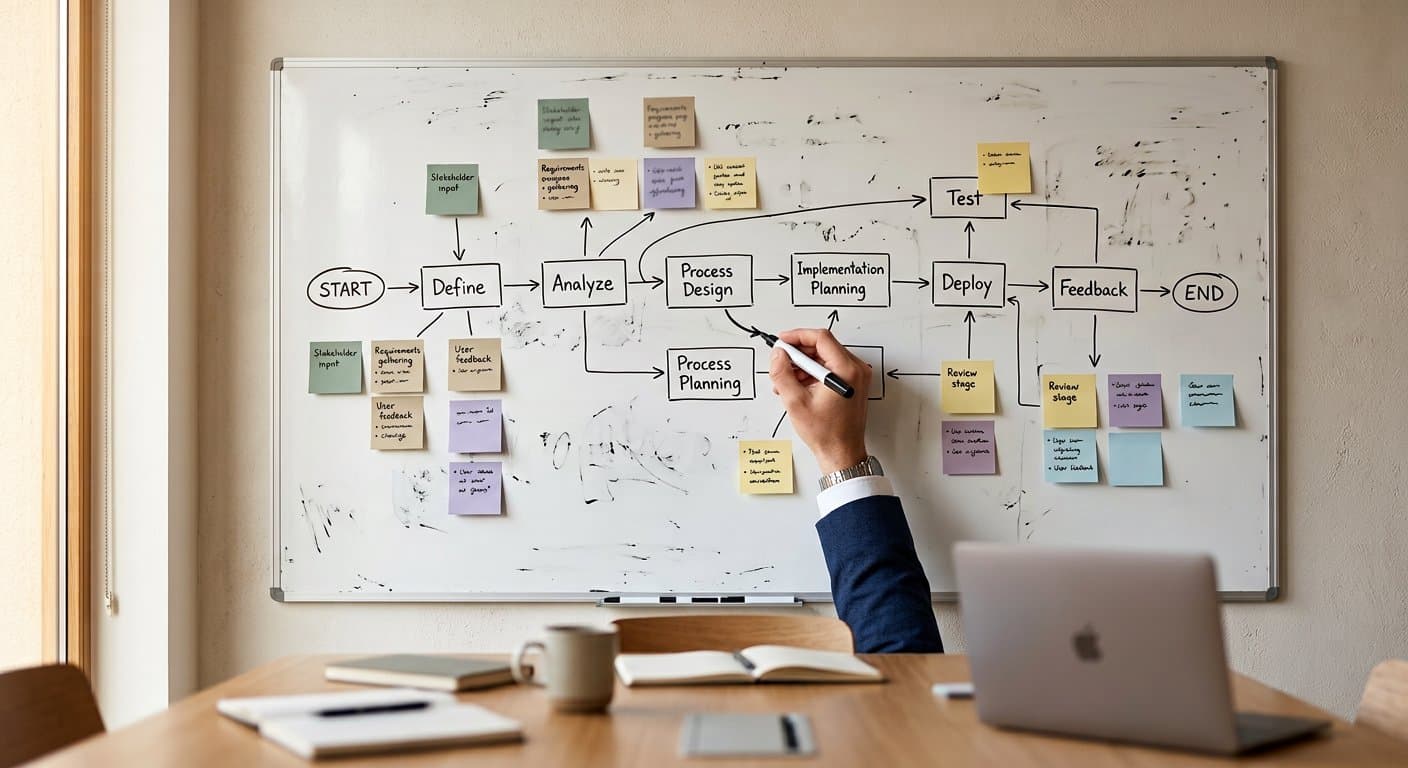
Process mapping
Understand the process before deciding what should be automated.

Human oversight
Keep judgment and escalation visible where the workflow requires them.
The next step
Tell VIEQAN where systems, information, or repetitive work are slowing the organization down. We will help determine what should be automated, integrated, rebuilt, or left alone.